 Mufei Li
545cc065c0
Mufei Li
545cc065c0
* Update

* Update

* Update

* Update

* Update

* Update

* Update

* Update

* Update

* Update

* Update

* Update

* Update

* Update

* Update

* Update

* Update

* Update

* Update

* Update

* Update

* Update

* Update

* Update

* Update

* Update

* Update

* Update

* Update

* Update

* Update

* Update

* Update

* Update

* Update

* Update

* Update

* Update

* Update

* Update

* Update

* Update
Property Prediction
Classification
Classification tasks require assigning discrete labels to a molecule, e.g. molecule toxicity.
Datasets
- Tox21. The "Toxicology in the 21st Century" (Tox21) initiative created a public database measuring toxicity of compounds, which has been used in the 2014 Tox21 Data Challenge. The dataset contains qualitative toxicity measurements for 8014 compounds on 12 different targets, including nuclear receptors and stress response pathways. Each target yields a binary prediction problem. MoleculeNet [1] randomly splits the dataset into training, validation and test set with a 80/10/10 ratio. By default we follow their split method.
Models
- Graph Convolutional Network [2], [3]. Graph Convolutional Networks (GCN) have been one of the most popular graph neural networks and they can be easily extended for graph level prediction. MoleculeNet [1] reports baseline results of graph convolutions over multiple datasets.
- Graph Attention Networks [7]. Graph Attention Networks (GATs) incorporate multi-head attention into GCNs, explicitly modeling the interactions between adjacent atoms.
Usage
Use classification.py with arguments
-m {GCN, GAT}, MODEL, model to use
-d {Tox21}, DATASET, dataset to use
If you want to use the pre-trained model, simply add -p.
We use GPU whenever it is available.
Performance
GCN on Tox21
| Source | Averaged Test ROC-AUC Score |
|---|---|
| MoleculeNet [1] | 0.829 |
| DeepChem example | 0.813 |
| Pretrained model | 0.833 |
Note that the dataset is randomly split so these numbers are only for reference and they do not necessarily suggest a real difference.
GAT on Tox21
| Source | Averaged Test ROC-AUC Score |
|---|---|
| Pretrained model | 0.853 |
Regression
Regression tasks require assigning continuous labels to a molecule, e.g. molecular energy.
Datasets
- Alchemy. The Alchemy Dataset is introduced by Tencent Quantum Lab to facilitate the development of new machine learning models useful for chemistry and materials science. The dataset lists 12 quantum mechanical properties of 130,000+ organic molecules comprising up to 12 heavy atoms (C, N, O, S, F and Cl), sampled from the GDBMedChem database. These properties have been calculated using the open-source computational chemistry program Python-based Simulation of Chemistry Framework (PySCF). The Alchemy dataset expands on the volume and diversity of existing molecular datasets such as QM9.
- PubChem BioAssay Aromaticity. The dataset is introduced in Pushing the Boundaries of Molecular Representation for Drug Discovery with the Graph Attention Mechanism, for the task of predicting the number of aromatic atoms in molecules. The dataset was constructed by sampling 3945 molecules with 0-40 aromatic atoms from the PubChem BioAssay dataset.
Models
- Message Passing Neural Network [6]. Message Passing Neural Networks (MPNNs) have reached the best performance on the QM9 dataset for some time.
- SchNet [4]. SchNet employs continuous filter convolutional layers to model quantum interactions in molecules without requiring them to lie on grids.
- Multilevel Graph Convolutional Neural Network [5]. Multilevel Graph Convolutional Neural Networks (MGCN) are hierarchical graph neural networks that extract features from the conformation and spatial information followed by the multilevel interactions.
- AttentiveFP [8]. AttentiveFP combines attention and GRU for better model capacity and shows competitive performance across datasetts.
Usage
Use regression.py with arguments
-m {MPNN, SchNet, MGCN, AttentiveFP}, Model to use
-d {Alchemy, Aromaticity}, Dataset to use
If you want to use the pre-trained model, simply add -p. Currently we only support pre-trained models of AttentiveFP
on PubChem BioAssay Aromaticity dataset.
Performance
Alchemy
The Alchemy contest is still ongoing. Before the test set is fully released, we only include the performance numbers on the training and validation set for reference.
| Model | Training MAE | Validation MAE |
|---|---|---|
| SchNet [4] | 0.0651 | 0.0925 |
| MGCN [5] | 0.0582 | 0.0942 |
| MPNN [6] | 0.1004 | 0.1587 |
PubChem BioAssay Aromaticity
| Model | Test RMSE |
|---|---|
| AttentiveFP [8] | 0.7508 |
Note that the dataset is randomly split so this number is only for reference.
Interpretation
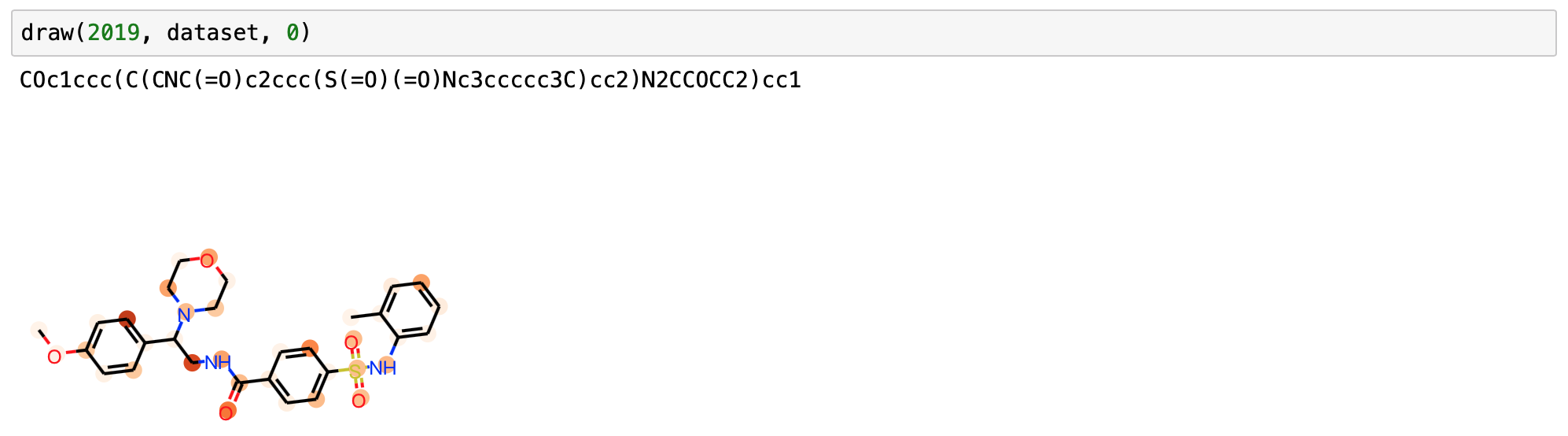
[8] visualizes the weights of atoms in readout for possible interpretations like the figure below.
We provide a jupyter notebook for performing the visualization and you can download it with
wget https://data.dgl.ai/dgllife/attentive_fp/atom_weight_visualization.ipynb.
Dataset Customization
Generally we follow the practice of PyTorch.
A dataset class should implement __getitem__(self, index) and __len__(self) method
class CustomDataset(object):
    def __init__(self):
        pass

    def __getitem__(self, index):
        """
        Parameters
        ----------
        index : int
            Index for the datapoint.

        Returns
        -------
        str
            SMILES for the molecule
        DGLGraph
            Constructed DGLGraph for the molecule
        1D Tensor of dtype float32
            Labels of the datapoint
        """
        return self.smiles[index], self.graphs[index], self.labels[index]

    def __len__(self):
        return len(self.smiles)
We provide various methods for graph construction in dgllife.utils.mol_to_graph. If your dataset can
be converted to a pandas dataframe, e.g. a .csv file, you may use MoleculeCSVDataset in
dgllife.data.csv_dataset.
References
[1] Wu et al. (2017) MoleculeNet: a benchmark for molecular machine learning. Chemical Science 9, 513-530.
[2] Duvenaud et al. (2015) Convolutional networks on graphs for learning molecular fingerprints. Advances in neural information processing systems (NeurIPS), 2224-2232.
[3] Kipf et al. (2017) Semi-Supervised Classification with Graph Convolutional Networks. The International Conference on Learning Representations (ICLR).
[4] Schütt et al. (2017) SchNet: A continuous-filter convolutional neural network for modeling quantum interactions. Advances in Neural Information Processing Systems (NeurIPS), 992-1002.
[5] Lu et al. (2019) Molecular Property Prediction: A Multilevel Quantum Interactions Modeling Perspective. The 33rd AAAI Conference on Artificial Intelligence.
[6] Gilmer et al. (2017) Neural Message Passing for Quantum Chemistry. Proceedings of the 34th International Conference on Machine Learning, JMLR. 1263-1272.
[7] Veličković et al. (2018) Graph Attention Networks. The International Conference on Learning Representations (ICLR).
[8] Xiong et al. (2019) Pushing the Boundaries of Molecular Representation for Drug Discovery with the Graph Attention Mechanism. Journal of Medicinal Chemistry.